

In the rugged contours of Nepal’s economy, remittances stand as a towering pillar of resilience and sustenance. Every year, millions of Nepali workers, scattered across the scorching deserts of the Gulf, the bustling cities of Malaysia, and beyond, send home billions of dollars that quietly power the nation’s financial heartbeat. In fiscal year 2082/83, these inflows reached approximately Rs 144.97 billion, equivalent to nearly 28.6% of GDP, far outstripping foreign direct investment, official development assistance, and even many traditional export revenues.
Remittance has become a massive source of foreign exchange that shores up reserves, stabilizes the balance of payments, and fuels household consumption across both urban and remote rural households. They have lifted millions out of poverty, funded education and healthcare, and kept the wheels of the domestic economy turning even amid global crises, earthquakes, and pandemics.
City Express Money Transfer. -
“जहाँ नेपाली, त्यहाँ सिटी एक्सप्रेस” - "Wherever there is a Nepali, there is City Express"
City Express Money Transfer has emerged as a vital lifeline in Nepal’s remittance ecosystem, bridging the emotional and financial distances between hardworking migrants abroad and their families back home. Founded in July 2007 and licensed by Nepal Rastra Bank, the company commands a significant market presence with around 18% market share, over 25,000 payout locations across the country and partnerships spanning more than 100 countries.
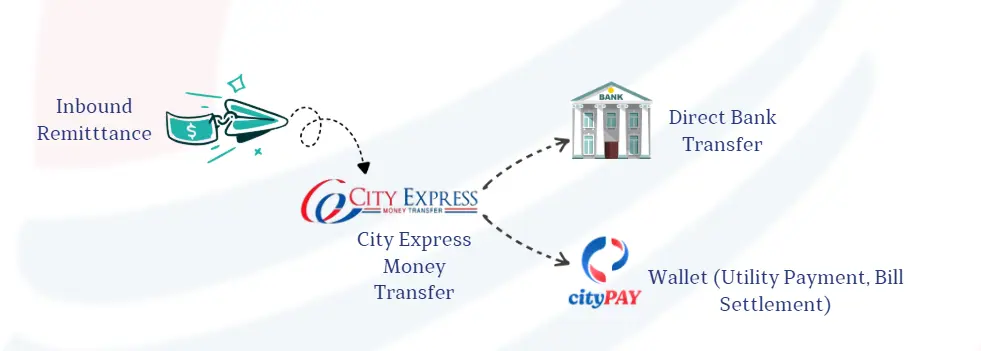
Beyond delivering fast, secure, and reliable financial transfers, whether through bank deposits, cash pickups, or instant digital wallets like CityPay, it understands that every remittance carries profound emotional weight: a father’s sacrifice turned into a child’s school fees, a daughter’s love manifested in funds for her parents’ healthcare, or a family’s collective dream of a better future. By ensuring swift, transparent, and doorstep-accessible services, City Express not only strengthens household economies and national foreign exchange reserves but also nurtures the unbreakable bonds of love and hope that sustain Nepal’s remittance-driven resilience.
While remittance remains its flagship enterprise, City Express Money Transfer operates within the structural architecture of the City Express Group, a diversified business house with established interests spanning financial services, information technology, trading, travel and tourism, hospitality, visa processing, and retail.
This diversified corporate footprint enables critical operational synergies. By leveraging internal technology frameworks and global logistics pipelines, the remittance business can continuously optimize transaction processing speeds and security. Guided by a unified institutional philosophy, the Group’s long-term objective is to deepen its multi-sector enterprise model in Nepal, anchoring commercial expansion in modern technology and stable governance. Across all active entities, the operational mandate remains consistent: converting regional growth into permanent institutional value.
The structural evolution of City Express is closely tied to the shifting dynamics of Nepal’s migration economy. In the early 2000s, a rapid rise in foreign employment across East Asia and the Gulf Cooperation Council (GCC) nations created an urgent macroeconomic demand for formal, regulated payment pipelines to replace entrenched informal systems like Hundi.
Positioning itself within this landscape, City Express systematically established direct bilateral channels with major financial institutions across primary migrant destinations. By prioritizing speed, transaction security, and administrative transparency, the company helped steer capital out of undocumented networks and straight into the formal banking system. This transition effectively provided the central bank, Nepal Rastra Bank (NRB), with greater visibility and control over sovereign liquidity.
Today, the company’s infrastructure connects major global labor hubs, including the Middle East, Malaysia, Japan, South Korea, Australia, Europe, and the United Kingdom, with remote agrarian districts across Nepal. By decoupling payouts from urban financial centers, the network ensures that incoming capital is distributed smoothly across different geographic segments, establishing the firm as a critical regulatory and financial conduit within the formal remittance ecosystem.
At the core of City Express's scale is a simple operational reality: every cross-border transaction carries profound household significance. Whether funding immediate utility bills, healthcare, quality education, or small-scale rural entrepreneurship, remittances function as a foundational stabilization mechanism against macroeconomic volatility.
For many Nepali workers abroad, a remittance transfer marks the completion of a month’s labour and the start of a family’s financial cycle back home. It is the micro-pivot upon which macro-liquidity turns. This continuous human cycle shapes the company’s strategy around operational continuity and accessibility. Rather than treating transfers as isolated transactions, the institutional architecture is designed to integrate the diaspora directly into the domestic financial mainstream, adapting to changing expectations in mobile platforms and cross-border digital settlement.
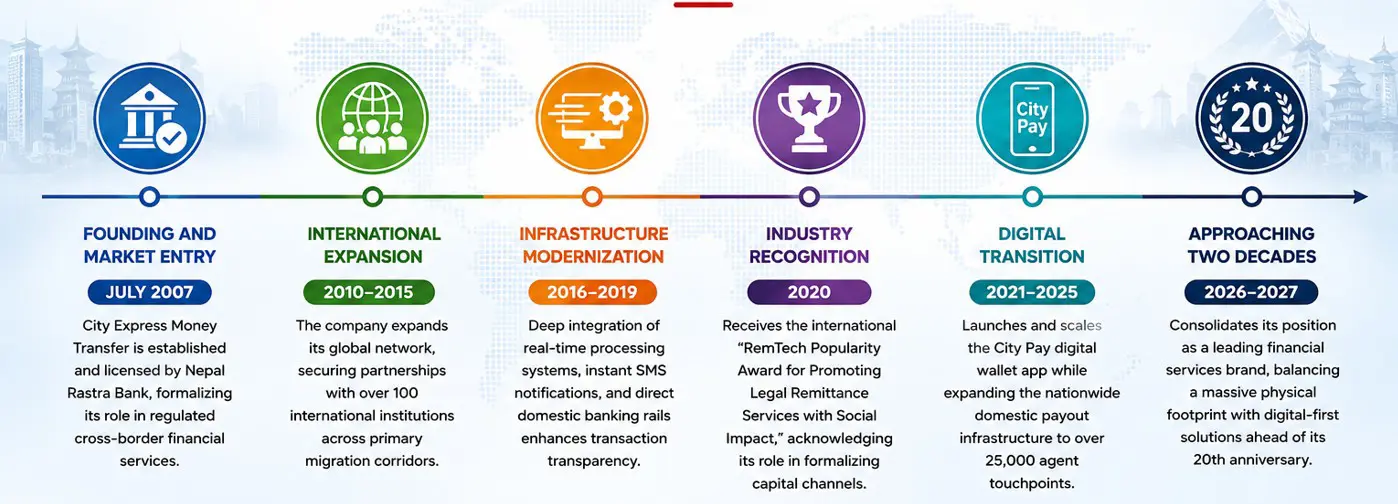
As we complete Two decades of operation, City Express has transitioned from a traditional cash-based remittance operator into a digital-first infrastructure provider. The company has invested heavily in real-time transaction processing engines, secure API integrations, and digital payout platforms.
A primary driver of this transition is the City Pay platform, a licensed digital wallet promoted by the company. City Pay enables users to receive inbound remittance funds directly onto their mobile devices and instantly deploy them for utility bills, merchant payments, and domestic transfers. By pairing this digital platform with its extensive physical agent network, City Express operates a robust hybrid model. This ensures that while urban and tech-savvy demographics benefit from mobile velocity, rural populations lacking smartphone access are not excluded from the financial system, reinforcing a structural commitment to comprehensive financial inclusion.
In cross-border finance, institutional credibility is maintained through rigorous compliance discipline. Operating under the strict supervision of Nepal Rastra Bank and corresponding regulators in partner jurisdictions, City Express maintains an internal risk management framework aligned with national and international standards.
To safeguard its pipelines, the company enforces strict Know Your Customer (KYC) procedures, requiring verified identification documents for every transaction. Advanced automated monitoring systems analyze velocity patterns in real-time to detect anomalous activity, ensuring large-value and suspicious transaction data flow directly to the Financial Information Unit (FIU-Nepal). This systematic oversight insulates the corridor from the systemic risks associated with capital flight, ensuring complete adherence to Anti-Money Laundering (AML) and Counter-Terrorist Financing (CTF) protocols.
City Express, throughout its 20 years of existence has prioritized giving back to the community and society in various form. We believe our contribution extends beyond providing quality service; it must also uplift and better our society. Adhering to this belief we have engaged in many activities, the most recent being:
Damage maintenance of Durbarmarg traffic police station during Genz movement.
Bhakta raj Acharya sangeet prastithan.

As City Express enters its third decade, its strategic roadmap centers on expanding cross-border fintech integration, lowering last-mile transaction costs, and diversifying the wealth-management products available to the global diaspora. With long-term objectives leaning toward deeper integration with banking services, the company is positioned at the intersection of traditional infrastructure and financial innovation.


Few sectors have shaped modern Nepal as profoundly as remittance. Behind every transf...
Read More
For thousands of Nepalis, moving to the United Arab Emirates (UAE) is a direct path...
Read More
Every year around International Workers’ Day (May Day), millions of Nepali worker...
 Head Office: City Express Complex Kamaladi, Kathmandu, Nepal
 Email: [email protected]
 Phone: +977-1-4531900